 Tricki
Quick description
Many results about arithmetic modulo a prime  that might seem hard follow naturally and easily from the (non-obvious) fact that the group of non-zero integers mod under multiplication is cyclic.
Prerequisites
This article is aimed at somebody who is meeting modular arithmetic and elementary number theory for the first time. The basic definitions and results are assumed, as is the definition of a cyclic group.
General discussion
Let  be a prime number. Then integers mod can be added and multiplied. Under addition, the integers mod form a cyclic group, since they are all generated by the number
  . If is a prime, in which case it is more usual to call it , then the non-zero integers mod form a group under multiplication as well: this is a much less obvious fact. The group axioms are easy to check, with the exception of the axiom that every element has an inverse. To see why this is the case, note that if is prime and
  is not a multiple of , then
  , so there exist integers
  and
and  such that
  , which tells us that
  . Thus, is a multiplicative inverse for .
The theme of this article is that the non-zero integers mod do not just form a group: they form a cyclic group. Moreover, the fact that they form a cyclic group is a fact that can be used. It is the latter that makes this topic appropriate for a Tricki article: however, the proof that the group is cyclic itself uses several beautiful and generalizable techniques, so we include it in an appendix.
One final remark: the results we prove here can also be proved without using the fact that the multiplicative group mod is cyclic. Since it takes a little work to prove that it is cyclic, there is a case for preferring the more elementary arguments. The merit of using the fact that the multiplicative group is cyclic is not that it gives the best proof of any individual result. But once you know that it is cyclic, a number of results follow very easily, so this approach has the effect of unifying a number of disparate facts and making their proofs seem less ad hoc.
Example 1: The multiplicativity of the Legendre symbol and Euler's criterion
A non-zero integer mod is called a quadratic residue if there is some  such that
  . The Legendre symbol
  is defined to be if is a quadratic residue and
  if is a quadratic non-residue.
An important fact about the Legendre symbol is that it is multiplicative: that is, 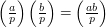 . Another well-known result is Euler's criterion, which states that
  . Let us see why both these results are obvious if the multiplicative group mod is cyclic (which it is).
To say that the multiplicative group is cyclic is to say that there is a generator. In other words, there exists a non-zero integer  such that every integer mod is congruent to some power of . This implies that the non-zero integers mod are
  , since if any two of these were the same then there would be fewer than
  distinct powers of and would not be a generator. Furthermore,
  , either by Fermat's little theorem, or by the observation that
  cannot be congruent to
  for some
  between 1 and
  without
  being congruent to
  , which we have argued is not the case.
Looked at from this perspective, the quadratic residues mod are just the even powers of . Why? Well, let be a quadratic residue. We know that we can write as for some between  and . If is a quadratic residue, then there exists such that
  , and can be written as
  with
with  between and . Therefore,
  . If
. If  , then this proves that
  , so is even. If
  , then
  , so
, so  , which is again even. (To put this more neatly, one might say that the quadratic residues are the numbers of the form where is a multiple of
  in the additive group mod . But since is even, the least residue of such a must be even.) Conversely, if is even, then is obviously a quadratic residue, since it is the square of
  . This proves that there are precisely
  quadratic residues.
Why is the Legendre symbol multiplicative? Because the above reasoning shows that  .
.
Why does Euler's criterion hold? Well,  but
but  ,
and the roots of
,
and the roots of  are
are  , so
, so  . And then we see that
  .
.
General discussion
What we are doing is looking at the integers mod on a "logarithmic scale". We take what is known as the discrete logarithm (base ), and difficult-looking multiplicative facts turn into easy-looking additive facts.
Example 2: The number of cubes mod
How many cubic residues are there mod ? The answer turns out to be that if is a multiple of  then there are
  of them, and otherwise there are .
To see this, let be a generator of the multiplicative group. The cubic residues are all numbers of the form  for some integer . So how many of these are there that are distinct mod ? To answer that, let us answer the following question: for which values of is it possible to find such that
  ?
?
To answer this question, we note that if and only if  mod . If is not a factor of then is invertible mod so the congruence mod is soluble for every . Therefore, there are cubic residues. If is a factor of , then the distinct multiples of 3 mod are
  , of which there are . And the result is proved.
Appendix
Not yet written.
Comments
Post new comment
(Note: commenting is not possible on this snapshot.)