 Tricki
Quick description
To prove a property  for all
  , first show that is equivalent to
  for all
  in the desired parameter space. Then, one only needs to verify for a single , which one can choose to make the verification as easy as possible.
Prerequisites
Probability theory
Example 1
(Lindeberg replacement trick) Suppose one wants to prove the central limit theorem, viz. that if  is a sequence of iid real-valued random variables with mean zero and variance
  , then the random variables
 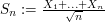 converge in distribution to the standard Gaussian random variable
  . For simplicity let us assume that all moments of the
  are finite. Lindeberg's proof of the central limit theorem proceeds in two steps:
-
(Base case) Verify the central limit theorem in the special case when the
are iid gaussians,  . In this case the theorem is easy, basically because the sum of two independent gaussians is still a gaussian.
 -
(Invariance) Show that for each
 , the asymptotic limit
  of the
  moments of
  remain unchanged if one replaces the iid sequence by any other iid sequence, say
  , with the same mean and variance. This is done by expanding out
  and observing that most terms only involve at most two factors of each , and so (by the iid hypothesis) only involve the first and second moments of the .
Indeed, once one has the invariance principle, one simply replaces the with a gaussian iid sequence and uses the base case.
General discussion
The replacement trick has also been used in random matrix theory; see this blog post for some further discussion.
Comments
Post new comment
(Note: commenting is not possible on this snapshot.)