 Tricki
Quick description
Suppose you have a function  and you would like to see that
  is
is  . One way to show this is to find a function
  such that
  and
and

The implicit function theorem will imply that is .
 |
Prerequisites
Calculus
Example 1
Deterministic and Stochastic Optimal Control, Wendell H. Fleming, Raymond W. Rishel, page 8. Take a cost function  and consider the calculus of variation problem of minimizing
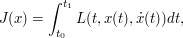
over piecewise
 functions
  with the given fixed end points
  and
and
 . A piecewise function is called an extremal of (1) if it satisfies

for  where
where  is a constant and where
  denotes the
variable of
denotes the
variable of  for which
  is substituted in (1) (the third variable).
Now let us assume that  and consider an extremal of (1) that is also , i.e., is continuous. We will show using the implicit function theorem that must be , i.e., if the extremal is then it has to be as smooth as the cost function .
 . This assumption precludes from sudden changes and forces it to be , even if this were not assumed. In order not to detract from the argument based on the implicit function theorem we assumed that is . The assumption
  will also come into play in the invocation of the implicit function theorem.
Now let us continue with our argument that must be as smooth as . The argument proceeds by induction. We already have the base case that is . Now let us suppose that it is  for a
for a
 . Then
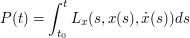
is as well. By (2)

for some constant . Define

is and and is , it follows that
 is .
We can rewrite (3) as
is .
We can rewrite (3) as 
 and this is strictly positive by assumption. These imply that
is at least as smooth as , thus is . It
follows that is
and this is strictly positive by assumption. These imply that
is at least as smooth as , thus is . It
follows that is  .
.
Comments
are there other examples of the argument in example one?
Sat, 25/04/2009 - 07:11 — devinThe above example has a more sophisticated method than the one I tried to describe in the quick description section. In the generalization of the method of example 1, there would be a function and the goal would be to improve our understanding of its smoothness. To that end, we use
  itself to define another function
such that ,
,  and
and  is as smooth as
  . Now the implicit function theorem says
  is as smooth as
  and hence
  . The argument is continued as many steps as possible. Does anyone know of another application of this argument, or an argument similar to this?
Notation
Thu, 07/05/2009 - 00:41 — Brendan MurphyThe notation " " isn't very clear. My first thought was: "partial derivative with respect to
  ". After this, I figured you meant the operator on
  given by the decomposition of
  (the Jacobian of
  ), since this is the condition required by the theorem. Still, the notation gives rise the possibility
  .
.
What does the notation mean in equation 2?
Instead of using , why not use
  ?
?
Notation
Sat, 09/05/2009 - 15:18 — devinThanks for the comment. I like the notation and frequently use it because it consisely states everything related to the operation (we are taking a derivative with respect to a variable.) The one you suggest (
 ) is also good I think. As for
  . This is common notation in many books, including Fleming and Rishel. I don't prefer it because I think it is confusing to use the same symbol to mean two entirely different things on the same page. In this case, if we use the
  notation,
  will mean the derivative of the function
  with respect to time and also the name of a free variable.
Post new comment
(Note: commenting is not possible on this snapshot.)