 Tricki
Quick description
If you are trying to calculate the sum  , then sometimes it is possible to spot another sequence
  such that
  and
and  . If that is the case, then your sum is equal to
  .
.
Prerequisites
The definition of an infinite sum.
 |
Example 1
An infinite sum that is well known to be straightforward to calculate exactly is the sum
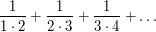
The usual technique for summing this is to observe that  , from which it follows that

which tends to 1 as  tends to infinity.
This points to a circumstance in which an infinite sum can be evaluated exactly: we can work out the discrete analogue of an "antiderivative": that is, we have a sequence  and can spot a nice sequence such that
  . Of course,
  must in that case be the partial sum
  (up to an additive constant). So is this really making the more or less tautologous observation that if you have a nice formula for the partial sums and can see easily what they converge to then you are done?
It isn't quite, because we could have spotted that without working out any partial sums.
General discussion
Let us try to understand better why the above trick is not a universal method for calculating all infinite sums, by contrasting the above example with the example of the sum
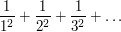
Can we find some sequence such that  ? It seems difficult just to spot such a sequence, so instead let us try to be systematic about it. It's not quite clear how to pick , so let us set it to be
  . Then
  , so
, so  . Next,
  , so
, so  . In general, we find that
  . Since we also want to tend to zero, this tells us what must be:
  , precisely the sum we were trying to calculate!
The reason the technique worked in the example above was that the partial sums turned out to have a nice formula.
 . This tends to
  as
as  tends to infinity. Now let

 . A smart student will use partial fractions to discover that this is a telescoping sum and will end up with the answer
  .
.If this method works, it is a bit like managing to calculate an integral by antidifferentiating the integrand.
Comments
Post new comment
(Note: commenting is not possible on this snapshot.)