 Tricki
Quick description
From Fubini's theorem one has the identity

for non-negative  . Thus, to estimate an integral, one way to do this is to control the measure of the level sets
  for different values of
  .
.
A slight variant: the  norm of a function can be expressed by the formula

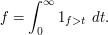
As another variant, one can view (1) as a means to decompose any non-negative function as a superposition of indicator functions:
Prerequisites
Measure theory
Example 1
Let  be a finite set, and let
  be a function. Show that

for any  .
.
Solution: we may as well normalize  , thus

If we insert this bound directly into (2) (using counting measure  instead of
  ) we obtain a logarithmic divergence. But we can improve the bound in two ways. Firstly, when
  , then
  , since there is no other non-negative integer less than
  . Secondly, we also have the trivial upper bound of
  , which is superior when
  . If we then use "divide and conquer" and partition the integral on the right-hand side of (2) into the regions , , and
  , one obtains the claim.
Example 2
Show that if a function lies in the weak spaces  and
and  for some measure space
  and some exponents
  , then it lies in the strong spaces
  for all
  .
.
We need to use "divide and conquer" efficiently in order to 'interpolate' the information we have at the endpoint weak spaces. The idea is that when the function is large, say  , then the norms increase when
  increases which is the same as saying that
  whenever
  and
and  . This indicates that we should split the integral
  into two parts; one integral over the set where is large and one over its complement. Then the integral over the region where is large is controlled by the weak
  norm of and the integral where is small is controlled by the weak
  norm of .
This can be done in a very elegant fashion by using the description (2) of the norm of a function. Indeed we can write

For the first term (which corresponds to the set where is small) we use the weak estimate

Similarly we get for the second term

Thus we have

and in particular 
More efficiently, one could split the integral at some point  instead of the point
  and then optimize in the parameter .
General discussion
This method is closely related to double counting and "interchange integrals or sums".
The method also combines well with dyadic decomposition. Indeed, one easily verifies that  is comparable to
  , and more generally
  is comparable (up to constants depending on ) to
  .
.
The Marcinkiewicz interpolation theorem relies heavily on these sorts of level set decompositions.
Comments
Post new comment
(Note: commenting is not possible on this snapshot.)