 Tricki
Quick description
The method of stationary phase is a collection of techniques used to estimate oscillatory integrals such as

where  is a smooth bump function,
  is a smooth real-valued phase function, and
  is a large real parameter. In many cases (particularly if the stationary points of the phase are isolated and non-degenerate), the methods give not only upper bounds, but a full asymptotic expansion of such integrals.
There are three main pillars of the theory:
-
Localization (the principle of non-stationary phase) If
is non-stationary (i.e.  ) on the support of , then the integral decays very rapidly in (faster than any power of ). This is proven by repeated integration by parts or by linearizing the phase. As a consequence, oscillatory integrals can often be localised to individual stationary points, particularly if such points are isolated.
-
Scaling The magnitude of an oscillatory integral around a stationary point decays at a rate determined by the order of stationarity (or more precisely, on the Newton polytope of the phase at a stationary point). One manifestation of this is the van der Corput lemma for oscillatory integrals.
-
Asymptotics If the phase is stationary and non-degenerate at a point, then one can perform a change of variables (using Morse theory) to place the phase in a canonical form, e.g. a diagonal quadratic form. This allows one to create asymptotic expansions for the integral around each such stationary point.
If all one is seeking is upper bounds on an integral such as  , and one is fortunate enough to have only one stationary point
  (i.e. only one solution to the equation
  , then a "quick and dirty" heuristic for "right" upper bound for this integral is this: the integral should be bounded by the amplitude
  at the stationary point , times the volume of the region
  near the point of stationary phase where the phase does not oscillate. (This can be viewed as a non-rigorous, oscillatory version of the base times height heuristic.)
Prerequisites
Harmonic analysis
Example 1
Problem (Fresnel-type integral) Let  be a compactly supported bump function that is non-vanishing at the origin. Obtain as good an upper bound as one can on the magnitude of the integral
  as a function of
  . [For sake of discussion, let's not keep track of the dependence on .]
Solution The base times height bound gives a crude upper bound of  . When
  , the phase
  only undergoes a bounded number of oscillations across the compact support of , so one does not expect any significant improvement to this bound except when is large. So now we will assume that
  .
.
The phase  is stationary at
  . Starting at this stationary point and then moving
  away from this point, we see that reaches its first full oscillation (i.e.
  or
or  ) when is comparable to
  . After that, it oscillates more and more rapidly, with the wavelengths becoming significantly smaller than as one moves away from the origin. So the "base" of this oscillatory integral is of size about
  , while the "height" is , leading to a prediction of .
To make this argument more precise, what one can do is perform a smooth dyadic partition of unity to decompose the bump function to a bump function  supported on the region
  , plus a telescoping sum of bump functions
  supported on the dyadic annuli
  , where
  ranges between
  and
and  .
.
Let's first consider the main term  . Here, there is no significant oscillation and one should apply the base times height bound, which gives a contribution of for this term.
Now let's look at one of the auxiliary terms  . On the region of integration
  , the phase is oscillating at a rate
  , which is about
  in magnitude; in other words, the phase has a wavelength of about
  . In contrast, the width of the cutoff function
  is about
  . Since the phase is oscillating faster than the cutoff, there is an opportunity to use integration by parts to exploit cancellation. Indeed, if we write this expression as

and integrate by parts, one obtains
![- \int e^{i \lambda x} \frac{d}{dx} [ \frac{1}{2 i \lambda x} a_m(x) ]\ dx.](../images/tex/eb4bc076e8e7390ccfd03b29331297a0.png)
Computing the derivative ![\frac{d}{dx} [ \frac{1}{2 i \lambda x} a_m(x) ]](../images/tex/b6b882af3c9483644ffec19a70853179.png) , one sees that the dominant term is
, one sees that the dominant term is  , which has size about
  . Applying the base times height bound, we thus see that this integral has a size of about
  . (Actually, one could repeatedly integrate by parts here and get even better decay in
  , but this is already enough decay to sum the series.) Summing in , one obtains the desired bound of
  for
for  .
.
The same analysis shows that if the amplitude function vanishes to some order  at the origin, then one obtains a bound of
  for the integral . The same is true if we take to be a Schwartz function rather than a bump function. Thus, to obtain asymptotics for (not just upper bounds), up to an error of , one can replace with some concrete Schwartz function approximant which agrees with to
  order at the origin, e.g. a polynomial times the gaussian
  . If one does this, one can get a full asymptotic expansion for ; see "linearize the phase" for the derivation of the first term of this expansion.
Example 2
Problem: (Frequency-localized fundamental solution for the Schrodinger equation) Obtain as good a bound as one can for the magnitude of the expression  , where is an integer,
  ,
,  , and is a bump function supported on the annulus
  . [For sake of discussion, let's not keep track of the dependence of constants on
  and ; the goal is to get the optimal dependence on
  .]
.]
Solution: Firstly, we normalize parameters by performing the change of variables  , giving

Thus, it suffices to handle the case  , as we can then get bounds for the other by substitution. We are now trying to bound

where is the phase

The base times height bound gives an upper bound of . To do better, we look at the gradient of the phase:

Thus we see that we have just one stationary point, at  , except when
  degenerates to zero.
Let's deal with the degenerate case first. When  , we just have a Fourier integral of a bump function; in addition to the trivial bound of , we will have a bound of
  for any
  by repeated integration by parts, so the correct bound here is
  (where we write
  ). A similar argument also handles the case when
  ; indeed, in such cases we can simply absorb the
  phase into the bump function
  and still get a bump function.
Now let's look at the non-degenerate case, when  . If
. If  is much larger than
  , e.g.
  , then the gradient of the phase is always at least
  for some absolute constant
  , so by repeated integration by parts we see that we can get a bound of in this case. Similarly, if is much smaller than , e.g.
  , then the gradient of the phase is always at least
  , so by repeated integration by parts we can get a bound of
  in this case.
The remaining case is when and  . Here, we expect the stationary point to lie inside the support of and so we longer get arbitrary amounts of decay. But we can now use stationary phase. First let's work heuristically: at the stationary point
  , we have
  , so we can Taylor expand
  . (In fact, this expansion happens to be exact in this case - by completing the square - but we will not exploit this.) Thus, we see that the stationary region
  consists of those
  for which
  , which is a ball of radius
  centred at
  . This ball has volume
  , and the amplitude function
  has height , so by base times height we expect a bound here of
  .
.
One can justify this heuristic by off-the-shelf stationary phase estimates. For instance, one can rewrite the integral as
![\int_{\R^d} a(\xi) e^{i t [ |\xi|^2 + \frac{x}{t} \cdot \xi ]}\ d\xi](../images/tex/4d77e10e0c2b96ec181b116724e5066f.png)
and apply stationary phase with being the asymptotic parameter and  being the phase; since we are restricting to the region , the phase is uniformly smooth and so the constants arising from the stationary phase bounds will not have any further dependence on .
Putting everything together, we obtain the following bounds on  , which turn out to be basically optimal:
-
A bound of
when  and
and  ;
; -
A bound of
 for any otherwise.
With more work, one can get asymptotics for these integrals, not just upper bounds.
Example 3
Problem: (Frequency-localized fundamental solution for the wave equation) Obtain as good a bound as one can for the magnitude of the expression  , where is an integer, , , and is a bump function supported on the annulus .
Solution: Again we can rescale ; this time, the scaling relation is given as

It is also convenient to exploit some more symmetries: we can flip  to
to  at the expense of conjugating
  , so can normalize
  ; similarly, the integral is unchanged under rotation of , so we may assume is oriented along the
  direction, thus
  for some
  .
.
So now we look for upper bounds of  . As before, when
  we obtain the bounds of from base times height, and from repeated integration by parts, leading to a net bound of
  in this case.
Now take  . Here, the derivative of the phase
  is
is
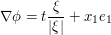
so a stationary point will now occur along a ray  if
if  , and no stationary point will occur otherwise.
We can dispose of an easy case when  is large, e.g.
  . Here the phase has gradient at least
  everywhere for some
  , and repeated integration by parts gives the bound
  . Similarly, when is small, e.g.
  , the gradient is at least
  everywhere, and repeated integration by parts gives the bound
  . So we may assume that
  .
.
We know that the ray is going to be the most dangerous region, so we now try to localize there. We thus write  where
where  and
and  . In the region where
  is large, e.g.
  , or when
  is not large and negative, e.g.
  , the gradient of the phase
  is at least
  by (1), and by smoothly truncating to this portion of the domain of integration we see that the contribution here is . So now let us localize to the remaining portion, where
  and
and  , say (the exact numerical values here are not important).
At this point, it can clarify things heuristically to try to linearize the phase. As is large and is small, we can Taylor expand

where we use the approximation  . Thus the phase is roughly of the form
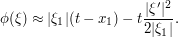
This expansion highlights the fact that the phase is at its most stationary when  and
and  .
.
Let's first handle the extreme case . Here, the phase is indeed stationary at  (where it is zero), and the stationary region is basically the cylinder where
  . This cylinder has volume
  , so this would heuristically be the bound for the integral in this case. To do this rigorously (and using the original phase, rather than the heuristic approximation to this phase), one can perform (smooth) dyadic decomposition to this cylinder, plus the remaining cylinders
  . The original cylinder yields a contribution of by the base times height bound. On the remaining cylinders, there is some non-trivial oscillation in the
  direction; exploiting that by repeated integration by parts, we eventually see that the contribution of the
  cylinder is
  (say), so on summing we do get as claimed.
Now we can handle the general case  . This is as before, but now there is also some oscillation along the axis as well as in the
  direction. For instance, in the cylinder
  , we can improve upon the trivial bound of to obtain
  for any , and similarly for the other cylinders, to on summing we now get a net bound of .
Putting all this together, we get the bounds

for all  .
.
Example 4
Problem: (Frequency-localized fundamental solution for the Klein-Gordon equation) Obtain as good a bound as one can for the magnitude of the expression  , where is an integer, , , and is a bump function supported on the annulus .
Solution: This is a particularly tricky one, requiring quite a few computations and cases.
Once again, we try to rescale . But this time, we run into a hitch: the phase  is not scale-invariant, so we cannot eliminate completely. Instead, we get

where

As before, we can exploit some symmetries and reduce to the case and for some  .
.
If we first look at the limit  , we see that this integral collapses to the integral considered in the preceding exercise. At the other extreme
  , we have a Taylor expansion

and the situation begins to more closely resemble the Schrodinger example. So it looks like we may have to divide into cases, with large behaving like the wave equation, and small behaving like the Schrodinger equation.
The case  can in fact be handled by the Schrodinger methods without much difficulty. Guided by the approximation (2), we can write

and one checks that  is smooth on the support of uniformly for , and furthermore
  is uniformly non-degenerate. Off-the-shelf stationary phase tools then give the bound
  if
if  and
and  , and
, and  for any
  otherwise.
Now let's look at the case when  . As before, we get a bound of when , so suppose .
The gradient of the phase  is
is

As in the wave case, we can then use repeated integration by parts to obtain a decay of when  and
and  when
when  , so we can restrict attention to the case when
  .
.
We expect the phase to be stationary near the negative axis, so we try Taylor expansion around that ray. Writing  as before, we obtain

In the case when  , the term
  is of bounded size, and so we do not expect this term to contribute much to the bounds. In other words, in this case the bounds should be the same as those for the wave equation, namely
  for any . And indeed, one can check that the arguments in the previous exercise can be repeated in this range of to give the stated bound.
Finally, we look at the case when  . If
. If  is much larger than
  , then the phase oscillation from the
  term is greater than that from the term, so the wave equation arguments will still give a bound of .
If instead  , then the portion
  of the (Taylor approximation of the) phase will have a stationary point, with a second derivative of roughly . From the approximation (4), we thus expect the stationary region to have size about
  in the direction and
  in the other directions, leading to a prediction of
  for the size of the integral. This can be made rigorous by first dividing the region of integration into cylinders as in the previous example (i.e. smoothly partitioning the variable around the critical value ), and then partitioning those cylinders further in the direction, based on the stationary point indicated in (3). We omit the rather tedious computations, and instead just give the final bounds for
  after putting all the above cases together, which are
-
 if ,
if ,  and ;
and ; -
 for any in all other cases with ;
 -
 when
when  and
and  or
or  ;
; -
 if ,
if ,  , and
, and  .
.
General discussion
The methods can be adapted to deal with more general amplitude functions than bump functions by such tools as (smooth) dyadic decomposition.
A good discussion of the technique can be found in Stein's book on harmonic analysis.
The more classical method of steepest descent, based on contour shifting, can also reproduce some of the results of stationary phase.
A variant of the base times height heuristic can give a means to predict the right order of magnitude of an oscillatory integral  near a stationary point : the magnitude should roughly equal the "height" , times the size of the "base", defined as the set of points near where
  is within
  of
of  (i.e. the region near the stationary point where phase has not yet begun to oscillate). For instance,
  should be about
  in magnitude.
Comments
Title
Fri, 01/05/2009 - 16:31 — VickyIs there perhaps a more helpful title for this article? If you don't know what the method of stationary phase is, then it's entirely unclear what this article is about and which problems the method tackles!
Vicky, if you spot more of
Fri, 01/05/2009 - 18:23 — gowersVicky, if you spot more of those it would be great. I've just found one of my own: using the law of trichotomy. I'm about to change it to something more descriptive and imperative.
Fair enough
Sat, 02/05/2009 - 00:15 — taoI renamed it (and added another example, while I'm here...)
Post new comment
(Note: commenting is not possible on this snapshot.)