 Tricki
Quick description
When faced with an unpleasant looking cutoff condition in a quantity one wishes to estimate, try expanding that condition using Fourier analysis.
Prerequisites
Basic harmonic analysis
Example 1
The classic example of this technique is the Pólya-Vinogradov theorem. Let  be a prime, and write
  for the Legendre symbol: thus
  if
if  is a quadratic residue modulo and is
  otherwise. The Pólya-Vinogradov theorem states that if
  then
then
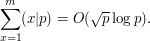
What this means is that, provided  , about 50 percent of the numbers less than
  are quadratic residues modulo .
There is a particular value of for which the result is very easy: when  , one is just counting the number of quadratic residues and nonresidues modulo (excluding zero), and it is well-known that there are
  . Thus

The only obstacle lying between this easy result and the Pólya-Vinogradov theorem is a cutoff hiding in the sum  . To see this more clearly let us write the quantity we are to bound as
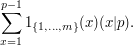
The notation  means a function which equals
  on the set
  and is zero elsewhere.
Now we apply the trick under discussion: we claim that the cutoff
and is zero elsewhere.
Now we apply the trick under discussion: we claim that the cutoff  may be expanded as a Fourier series
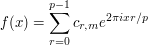
where  . To see this one uses (discrete) Fourier analysis on
  . The Fourier coefficients
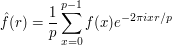
of  are just geometric series, the common ratio of series one must sum for
  being
being  . An easy exercise shows that
  , where
  is the size of
  when reduced to lie between
  and
and  . The claim now follows from the Fourier inversion formula.
Applying this decomposition of  and the triangle inequality, our task now follows if we can establish that
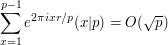
for all  . We have now completed the sum to the whole range
  , though we have paid the price of introducing the exponential
  .
.
It turns out that this is not a huge price to pay: these new sums are Gauss sums and it is possible to show that they are  . We leave the details as an exercise (the solution to which may be found in any number of places).
Example 2
This trick is ubiquitous in analytic number theory. It is very important, for example, in the treatment of sums  using the so-called method of bilinear forms; see B. Green's article Three topics in additive prime number theory, Chapter 2, for more information.
Example 3
Suppose one has an integral operator

which one knows to be bounded from  to
to  for some
  . Then, given any bump function
  , the smoothly truncated bump function

is also bounded from to (and in fact the operator norm of  is bounded by that of
  , times a constant depending only on
  ). To see this, observe that the support of can be placed in a box
 ![[-L/2,L/2]^2](../images/tex/411667642df4e5043bc7ae52a6a27289.png) for some sufficiently large
for some sufficiently large  . Performing a Fourier series expansion, one can write
![\phi(x,y) = 1_{[-L/2,L/2]}(x) 1_{[-L/2,L/2]}(y) \sum_{n,m \in \Z} c_{n,m} e^{2\pi i nx/L} e^{2\pi i my/L}](../images/tex/aabdd637cd5d0cdf3ce0a4488070aebf.png)
for some rapidly decreasing Fourier coefficients  . Interchanging sums and integrals (neglecting for now the issue of how to justify this; in practice, one can create an epsilon of room and regularize
  and
and  as needed), we obtain
![T_\phi f(x) = \sum_{n,m} c_{n,m} 1_{[-L/2,L/2]}(x) e^{2\pi i nx/L} \int_\R K(x,y) (1_{[-L/2,L/2]}(y) e^{2\pi i my/L} f(y))\ dy.](../images/tex/f30604ae4a23919b3241a9e67396a77e.png)
Applying the triangle inequality, we conclude that
![\| T_\phi f \|_{L^q(\R)} \leq \sum_{n,m} |c_{n,m}| \| \int_\R K(x,y) (1_{[-L/2,L/2]}(y) e^{2\pi i my/L} f(y))\ dy \|_{L^q(\R)}.](../images/tex/9752b747c52f06da286f1af2cf2b4d01.png)
Thus if is bounded from to with operator norm , one has

and the claim then follows from the rapid decrease of the coefficients .
General discussion
Sometimes this principle is described as all cutoffs are the same, or as completing exponential sums. It can lead to extra logarithmic factors as in the Pólya-Vinogradov inequality mentioned above; in this example reducing the size of these factors is a major unsolved problem. Often it is very helpful to smooth the cutoffs before decomposing them into Fourier modes.
Comments
Post new comment
(Note: commenting is not possible on this snapshot.)